

Vitamin C vs Natural Brightening: Which Is Better for Glowing Skin?
When you want brighter, more even-looking skin, two approaches usually come up: vitamin C skincare and natural or herbal brightening ingredients that promise glowing skin. Both can have a real place in a routine, but they're not interchangeable, and they're not really rivals either — they're two different tools that happen to get marketed against each other.
Topical vitamin C has a comparatively stronger research base for antioxidant and pigment-related effects, while evidence for natural ingredients varies widely depending on the specific ingredient, formulation, and type of pigmentation you're dealing with. A "natural" label doesn't automatically mean a product is safer, gentler, or more effective — and a lab-made ingredient isn't automatically harsher.
The right choice depends on your skin type, what's actually causing your uneven tone, how sensitive your skin is, and how consistently you'll stick with the routine.
Quick answer: topical vitamin C has more standardized, better-studied evidence for improving uneven skin tone and dullness. Natural brightening ingredients can still work well, but their effectiveness varies enormously by ingredient — some (like licorice extract) have decent evidence, many don't. Neither is automatically safer or gentler for sensitive skin. The better strategy is picking one product that matches your specific concern and skin tolerance, using it consistently, and never skipping sunscreen.
Vitamin C vs Natural Extracts for Radiant Skin: A Full Comparison
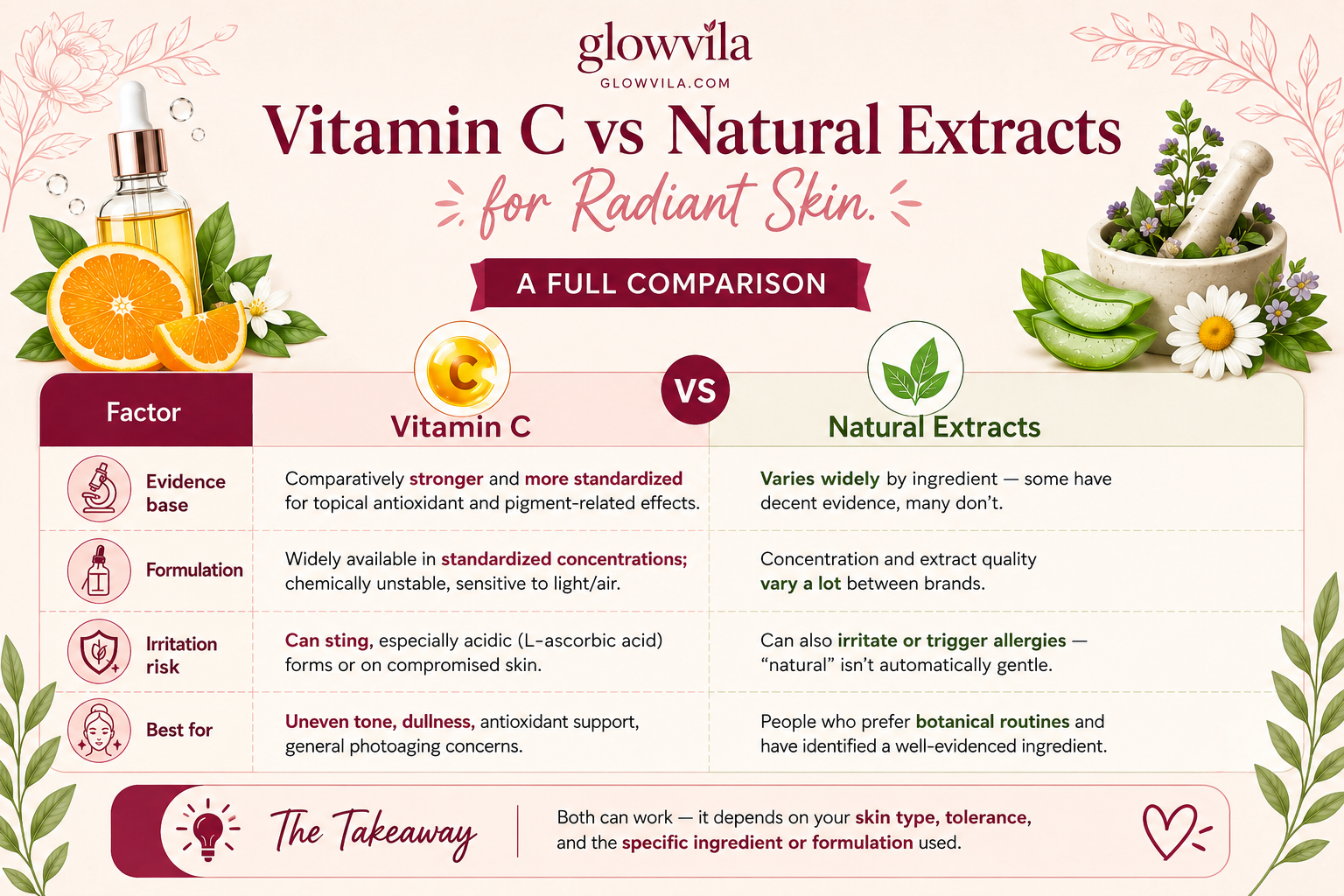
Here's the side-by-side breakdown before we go deeper into each category:
What Does "Skin Brightening" Actually Mean?
Skin brightening shouldn't mean changing your natural skin color. In skincare, brightening usually refers to improving the appearance of dull skin, uneven tone, sun-related pigmentation, or dark marks.
A tan, a post-acne dark mark, melasma, and general dullness can all require different approaches. Before picking a brightening ingredient, it helps to be clear on what you're actually trying to improve.
Vitamin C, particularly topical ascorbic acid, is an antioxidant used in skincare for photoprotection, collagen support, and pigmentation concerns. Research suggests it can influence melanin formation and may help improve uneven pigmentation.
Reviews of randomized trials on topical vitamin C have found measurable lightening effects on objective pigmentation assessments, so vitamin C helps address dullness even though the pool of high-quality trials remains relatively small, and noticeable results typically take consistent use over several weeks rather than days.
Vitamin C can be a useful option when your main goal is improving uneven tone while also adding antioxidant support to your routine.
Natural brightening refers broadly to plant-derived, food-derived, or naturally occurring ingredients used to support a more even-looking complexion, and some products lean on a natural source of botanical extracts. Examples include licorice extract, green tea, mulberry, turmeric, and aloe-derived compounds such as aloesin.
But "natural" is a broad category, not a measure of effectiveness, and natural forms of vitamin C are no exception. Reviews of natural ingredients for hyperpigmentation have found real evidence for some ingredients, while noting that many others lack strong human evidence. Natural brightening can absolutely be worthwhile — the specific ingredient and formulation just matter far more than the word on the label.
People often ask about natural and synthetic vitamin C, wondering whether one is inherently better for skin health. The truth is that natural vitamin C, drawn from fruit or plant sources, and synthetic vitamin C, made in a lab, are often chemically very similar once purified. A serum with vitamin C derived from a botanical source isn't automatically superior to a well-formulated lab version — what matters is stability, concentration, and how the finished product performs on your skin.
Beyond the active ingredient itself, vitamin C serums and natural brightening creams tend to differ in format, stability, and how they're used:
Texture and format: vitamin C is usually sold as a lightweight serum meant to be layered under moisturizer; natural brightening products are commonly formulated as creams, which can feel more occlusive and moisturizing on their own.
Stability: vitamin C, especially L-ascorbic acid, is chemically unstable and degrades with light, air, and heat exposure — packaging and freshness matter a lot. Plant extracts are generally more stable, though extract quality and concentration still vary between brands.
Concentration clarity: vitamin C products typically state a percentage (e.g., 10%, 15%, 20%), making potency easier to compare. Natural brightening products less consistently disclose extract concentration, which makes comparing products harder.
Onset: both categories generally require weeks of consistent use — neither is a same-day fix, regardless of what packaging claims.
Vitamin C works primarily as an antioxidant that also appears to interact with pathways involved in melanin production, which is why it's linked to both pigment-related benefits and protecting skin from environmental stressors through general oxidative-stress protection.
Natural brighteners work through more varied mechanisms depending on the ingredient. Licorice-derived compounds have been studied for pigment-modulating effects; green tea's polyphenols primarily offer antioxidant support; aloesin has been researched in relation to pigmentation, though with a smaller evidence base than the marketing around "aloe brightening" often implies. In short: vitamin C has one well-characterized mechanism with solid backing, while natural ingredients are a group of different mechanisms with uneven levels of proof behind each one.
Supports antioxidant protection against environmental oxidative stress
Can help improve the appearance of uneven pigmentation
Supports normal collagen production, which is tied to skin elasticity
Complements a sun-protection routine
Available in standardized, percentage-labeled topical formulations
Natural Brightening: Potential Benefits
Some botanicals contain compounds that may influence pigmentation pathways
Some provide genuine antioxidant support
Certain ingredients can support a more comfortable skin barrier
Offers an option for people who prefer botanical-focused routines
The key distinction: these brightening benefits are ingredient-specific. Licorice extract, green tea, turmeric, and other botanicals shouldn't all be treated as equally proven brightening treatments just because they share the "natural" label.
Which Is More Effective for Dark Spots?
For someone specifically targeting dark spots or uneven skin tone, topical vitamin C generally has a more established research base than the broad category of "natural brightening." That doesn't mean vitamin C is guaranteed to work, or that every vitamin C serum performs the same.
Clinical research has found objective improvement in dark spots with topical vitamin C, while also emphasizing that available trials are limited and noticeable changes usually require consistent use over time. Natural ingredients can be genuinely useful when there's real evidence for that specific ingredient — but the strength of that evidence varies substantially from one botanical to the next.
Is Vitamin C or Natural Brightening Better for Sensitive Skin?
Neither category is automatically better for sensitive skin types. Vitamin C can sting, especially in acidic formulations (like pure L-ascorbic acid) or when your skin barrier is already compromised. Botanical extracts and essential oils can just as easily irritate sensitive skin or trigger allergic reactions in susceptible people — plant-derived doesn't mean risk-free.
If your skin is sensitive, prioritize a simple formulation over a trendy one, introduce only one new product at a time, and patch test according to the product's directions before applying it to your whole face.
Gentle Alternatives to Vitamin C for Sensitive Skin Glow
If straight vitamin C tends to sting your skin, these are commonly better tolerated while still supporting brighter skin and a more even look:
Derivative forms of vitamin C (sodium ascorbyl phosphate, magnesium ascorbyl phosphate) — a gentler vitamin C derivative than pure L-ascorbic acid, though often less potent
Niacinamide — widely tolerated, supports barrier function and a more even tone
Azelaic acid — commonly used for uneven tone and considered gentle enough for reactive skin at appropriate concentrations
Licorice root extract — one of the better-evidenced botanicals for pigment support, generally well tolerated
Centella asiatica (cica) — soothing profile that can offset irritation from other actives in a routine
If you're not sure which of these fits your skin, introduce just one at a time and give it several weeks before judging results.
Natural Brightening Ingredients That Enhance Skin Glow Without Irritation
Some botanicals have a track record of being both reasonably evidenced and gentle brightening ingredients — a combination that's harder to find than marketing suggests:
Licorice extract — investigated for pigment-modulating effects, usually well tolerated in finished formulas
Green tea — antioxidant support from polyphenols, low irritation risk for most people
Oat extract — soothing and barrier-supportive, useful when layered with more active ingredients
Centella asiatica — calming and brightening support, commonly used alongside actives to offset irritation
Aloe-derived compounds — mild antioxidant and soothing profile, though pigment-specific evidence is more limited than marketing implies
Turmeric is worth a specific caution here: it contains curcumin and other compounds with antioxidant and anti-inflammatory properties, but topical turmeric preparations can irritate or stain skin in some people — gentle formulation and patch testing matter more with turmeric than with most botanicals on this list.
Are There Any Side Effects of Using Strong Vitamin C for Brightening?
Yes, and they're worth knowing before you start with a high concentration:
Stinging or burning, especially with pure L-ascorbic acid or on already-irritated skin
Redness or flushing, particularly during the first few uses
Dryness or flaking if introduced too quickly or layered with other strong actives
Product oxidation — a vitamin C serum that's turned dark yellow or brown has degraded and can be more irritating and less effective
Increased sun sensitivity in some formulations, which makes daily sunscreen non-negotiable alongside it
If a product causes persistent burning, swelling, or a rash, stop using it and consider a gentler derivative or a lower concentration before trying again.
Vitamin C vs Natural Brightening for Different Skin Concerns
For Sun Tan
Sun protection is the priority here, full stop. Vitamin C may provide antioxidant and pigment-supporting benefits, but it doesn't instantly remove a tan. Natural ingredients should also be viewed as supportive rather than instant tan removers.
For Post-Acne Dark Spots
Vitamin C can be one option for supporting a more even appearance on acne-prone skin. Other evidence-based ingredients may also suit acne-prone skin, depending on your skin and the specific type of pigmentation you're dealing with.
For General Dullness
Either a well-formulated vitamin C product or a gentle botanical-focused routine may help improve the appearance of dullness. Consistent cleansing, moisturizing, and sun protection remain more important than chasing multiple brightening products at once.
For Melasma
Melasma is more complex than ordinary dullness or a mild tan. Vitamin C may have a supporting role, but persistent or significant melasma often needs professional assessment and a targeted treatment plan rather than an over-the-counter approach alone.
Does Natural Mean Safer?
No. "Natural" and "synthetic" aren't reliable shortcuts for judging safety. A plant extract can contain biologically active compounds and irritate or sensitize some people just as readily as a lab-made ingredient. A synthetic ingredient can also be extremely well tolerated when properly formulated.
What actually matters is the complete formulation, concentration, stability, your skin's current condition, and your individual response — not which column the ingredient falls into on the label.
Comparing Vitamin C and Natural Brightening Serum Ingredient Lists
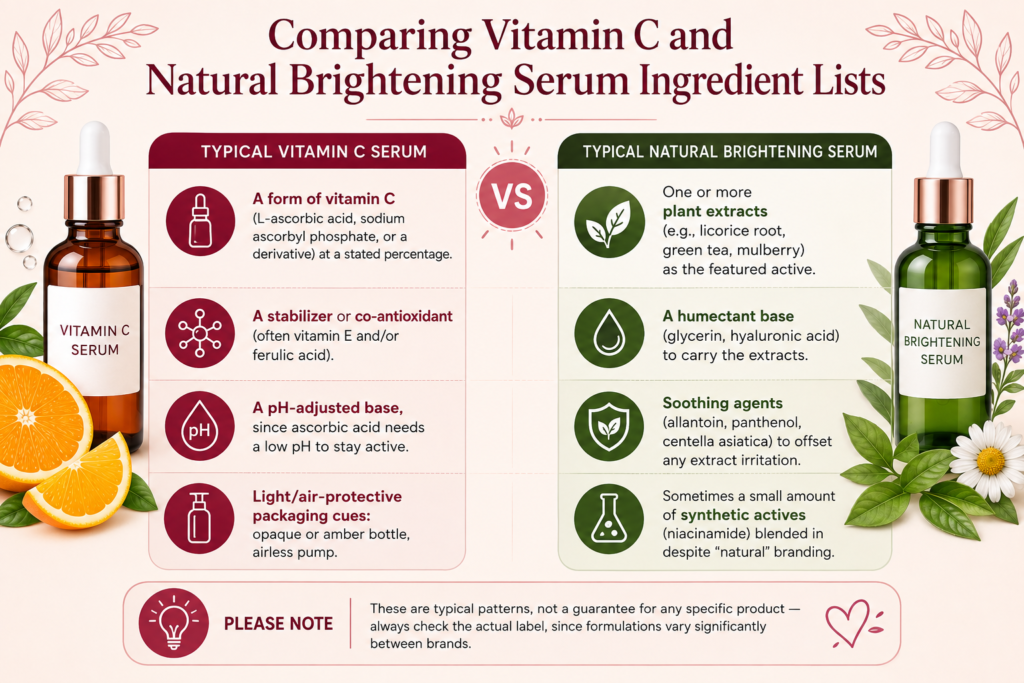
Reading an ingredient list is more useful than reading marketing copy. Here's what each type of serum typically looks like on the back of the bottle:
Note that these are typical patterns, not a guarantee for any specific product — always check the actual label, since formulations vary significantly between brands.
Which Skincare Products Combine Vitamin C and Niacinamide With Natural Brightening for Glowing Skin?
A growing number of formulations blend a stable vitamin C derivative with botanical extracts — pairing, say, sodium ascorbyl phosphate with licorice root or green tea, plus a soothing agent like centella asiatica to offset potential irritation. Some even combine vitamin C and niacinamide in one bottle, aiming for the best of both worlds in a single step.
If you're evaluating a hybrid product, look for:
A clearly stated vitamin C form and, ideally, concentration — not just "vitamin C complex" with no specifics
Named botanical extracts rather than a vague "natural brightening blend"
A soothing ingredient included specifically to balance the actives (centella, allantoin, panthenol)
Stable, protective packaging — opaque or amber glass, airless pump, since vitamin C degrades in light and air
A patch-test recommendation on the label, which is a good sign the brand is accounting for irritation risk
Combination formulas can be a reasonable middle ground, but more ingredients isn't automatically better — a shorter list of well-chosen, well-concentrated ingredients usually outperforms a long list of trace-amount extras.
Can a Natural Vitamin C Serum Outperform Standard Vitamin C for Skin Glow?
For general glow and antioxidant support, sometimes — for targeted pigmentation, not usually, based on the current evidence, and this holds whether a product contains natural vitamin c or a lab-made form. A well-formulated natural vitamin c serum with an evidenced ingredient (like licorice extract at a meaningful concentration) can absolutely deliver noticeable results, especially for people whose skin doesn't tolerate stronger vitamin C well.
But as a category, natural brightening doesn't have the same weight of standardized clinical evidence behind it that topical vitamin C does. The more accurate framing isn't "which wins" — it's "which evidenced ingredient, in which formulation, fits your skin and your specific concern."
Can You Use Vitamin C and Natural Ingredients Together?
Potentially, yes. But more ingredients don't automatically mean better results. If you want the best results from combining approaches, start with a simple skincare routine and introduce products gradually:
Start with one brightening product
Use it consistently for several weeks rather than switching every few days
Monitor for burning, persistent redness, itching, or peeling
If your skin tolerates it, add another targeted product only when there's a clear reason to
Keep daily sun protection as the non-negotiable foundation of the routine
How to Choose the Best Vitamin C Product
When choosing the best vitamin C for your routine, look for a clearly stated form of vitamin c and concentration when it's provided
Choose packaging that protects the formula from light and air (opaque bottle, airless pump)
Start gradually if your skin is sensitive
Avoid introducing it at the same time as several other strong actives
Follow the product's storage and use instructions — vitamin C degrades faster than most actives
Vitamin C is chemically unstable, and formulation quality genuinely affects how well vitamin c for skin performs. Stability and skin penetration are real, practical considerations with topical vitamin C — not just marketing fine print.
What to Look for in a High-Quality Natural Brightening Serum
A named, specific active — "licorice root extract" beats "botanical brightening complex" every time
A stated concentration or position high on the ingredient list — extracts buried at the bottom of a long list are likely present in trace amounts only
Evidence behind the specific ingredient, not just the plant family it's derived from
A soothing base (glycerin, hyaluronic acid, panthenol) that supports rather than undermines the skin barrier
Transparent sourcing or extraction method, when the brand provides it — a sign of a more serious formulation
Realistic claims about its brightening properties — be cautious of any product promising overnight or dramatic pigmentation changes
How to Choose Between Vitamin C and Natural Brightening Based on Your Skin Type
Oily or resilient skin: often tolerates standard vitamin C serums well; a higher concentration may be an option if introduced gradually
Dry or barrier-compromised skin: a gentler vitamin C derivative or a soothing natural formula (centella, oat, licorice) paired with a rich moisturizer is usually more comfortable
Reactive or easily irritated skin: start with the gentlest option available in either category, patch test first, and introduce nothing else at the same time
Combination skin: a lightweight vitamin C serum in oilier areas and a richer natural or derivative-based product in drier areas can work, though simplicity is still the safer starting point
Skin with a history of allergic reactions to botanicals: when you're choosing between natural extracts and a standardized vitamin C derivative, the derivative may be the more predictable choice, since its formulation is easier to control and label accurately
Niacinamide or Vitamin C: Which Is Better for Sensitive Skin?
This is worth repeating on its own, since it's one of the most common questions — and it often comes down to niacinamide or vitamin c: there's no universal winner here. What matters far more than the category is the specific formulation, the concentration, and how your individual skin responds. A gentle vitamin C derivative can outperform a harsh, high-concentration botanical extract for sensitive skin, and vice versa. Treat both as "it depends," not as a fixed rule.
What Customer Reviews Say About Vitamin C vs Natural Brightening for Glowing Skin
Individual product reviews vary too much to generalize into a single verdict, but a few patterns show up consistently across skincare communities and retailer review sections:
Vitamin C reviews often mention a noticeable initial "glow" effect, along with occasional complaints about stinging, a strong scent, or the product oxidizing (turning yellow/brown) before it's used up.
Natural brightening reviews more frequently describe a gentler feel and slower, subtler results, with occasional reports of breakouts or irritation tied to a specific extract or added fragrance.
Across both categories, reviewers who report the best results tend to describe using the product consistently for 6–12 weeks — reviews left after just a few days rarely reflect the ingredient's real performance.
Treat reviews as a general signal of tolerability and texture preferences, not as a substitute for checking the actual ingredient list and concentration.
What About Lemon Juice and DIY Brightening?
Lemon juice, baking soda, harsh scrubs, and undiluted kitchen ingredients are not good substitutes for properly formulated skincare products. Irritation can make pigmentation look worse, especially after inflammation. If a DIY treatment burns or leaves your skin red, stop using it.
The Most Important Step: Sunscreen to Protect Your Skin
Whether you choose vitamin C, natural ingredients, or neither, sun protection is essential to protect your skin when your goal is even-toned skin. Ultraviolet exposure contributes to pigmentation and can undermine any progress from brightening products.
Vitamin C can complement photoprotection, but it doesn't replace sunscreen. Use a broad-spectrum sunscreen consistently and reapply as appropriate for your sun exposure.
Vitamin C vs Natural Brightening: Which One Should You Choose?
Choose to use vitamin C if you want a standardized, comparatively well-studied antioxidant ingredient with evidence for pigment-related benefits, and you can tolerate it.
Consider a natural brightening ingredient if you prefer botanical skincare and the specific ingredient has a reasonable evidence base in a well-formulated product.
You don't have to choose one category forever. The better strategy is to pick a small number of products that match your concern and skin tolerance, then use them consistently.
A Simple Brightening Skincare Routine
Morning
Gentle cleanser, if needed
Vitamin C serum or another suitable brightening product
Moisturizer, if needed
Broad-spectrum sunscreen
Night
Gentle cleanser
Moisturizer
One targeted treatment, if appropriate for your concern and skin tolerance
A vitamin C eye cream is optional, but if you use one, treat it as its own gentle step rather than doubling up with a strong serum around the eyes.
Common Mistakes to Avoid
Using several brightening actives at once
Assuming stronger concentrations always work faster
Using lemon juice or abrasive DIY scrubs
Skipping sunscreen while treating pigmentation
Changing products before giving a routine enough time to assess tolerance
Assuming a natural ingredient can't cause irritation
Frequently Asked Questions
Everything you need to know before starting your skincare journey.
Vitamin C and natural brightening aren't really competitors — comparing vitamin C with botanical options is less about a winner and more about fit. They represent different approaches to the same goal: healthier-looking skin with a more even tone.
If you want a standardized ingredient with comparatively stronger clinical evidence, topical vitamin C is a reasonable choice for maintaining healthy skin. If you prefer botanical skincare, choose specific natural ingredients based on evidence and formulation quality — not the word "natural" alone.
Most importantly: protect your skin from the sun, keep your routine simple, introduce products gradually, and give a consistent routine enough time to work. Brightening is a process, not an overnight transformation.